I was in the midst of a panic spiral. I was thinking of moving to another state for the first time ever, leaving behind family, friends and everything familiar. My friend SV was on the phone, attempting to talk me off the ledge.
“I don’t think I can live in the Eastern time zone,” I argued. “I’m a Central time zone person my whole life. Primetime doesn’t start till 8! Do people in the Eastern time zone not have to get up for work?” (This was pre-DVR and streaming.)
“Uh, I live in the Mountain time zone,” SV said. “It is INSANE. Stuff starts at the most random times. You’ll adjust.”
“But I don’t want to leave behind my friends.”
“You’ll make new friends.”
“I don’t WANT new friends. I like the ones I have.”
In my experience, people approach change in two ways: You’re either a person who thinks about everything you’re gaining, or a person who thinks about everything you’re giving up.
SV is the former, and she is brave and amazing. Right after college, she packed her life into a car and drove to Montana to work for a minor league baseball team. For the past decade, she’s been a foreign service officer for the U.S. State Department, uprooting her life and moving to a new country every 2-3 years.
Me, on the other hand? I put down roots as quickly and deeply as possible. I grew up on a farm owned by my great-grandma, in a house my grandpa built and my dad grew up in. My family’s lived in the same Iowa town since the 1840s. When I did finally choose to move to Michigan (yes, I went through with it), I picked Grand Rapids precisely because it was a large enough city to have cultural and work opportunities, but small enough to be livable long term. (Spending a semester in London and a summer in D.C. taught me that for me, metropolises are much more fun to visit than do daily life in.)
Many of the best things in my life have come from pushing myself out of my comfy little rut and forcing myself to try something new.
I’ve now been in Grand Rapids 20+ years. I’ve been at the same company for 20 years, and whenever I think about applying for jobs somewhere else – yup, I start running through the list of everything I’d be giving up.
And yet. So much of this mindset is about fear, and that’s completely counter to how I want to live my life … and how I want my daughters to live theirs. I believe in living life intentionally, and you can’t do that if you’re always playing defense. I want to be open to opportunities, to the unexpected gifts life can give you – an out-of-the-blue job offer, a chance to start fresh somewhere new, falling in love with someone who has no interest in moving back to Iowa with you. And I want to be able to bend, not break, at the surprises life inevitably brings – loss of a job or spouse, cancer diagnosis, an accident, a financial reversal.
I also know that many of the best things in my life have come from pushing myself out of my comfy little rut and forcing myself to try something new. I intentionally chose a college that no one I knew attended, because I wanted to see who I was apart from the context of multi-generation family associations. It was a transformative experience for my identity, my Christian faith and my life. It was there I met the friend who ended up telling me about the job opening a few years later in Grand Rapids, which prompted my first out-of-state move and where I ended up meeting my husband of 18 years.
And the benefits of trying new things have come not just from the thing itself, but from the mental and emotional stress it’s forced on me. My first year of college was awful. I didn’t get along with my roommate. I had some people I socialized with but no real friends. I felt completely out of place. Same with my first year in GR. I remember those as the loneliest years of my life. Yet I stuck it out and made it through to a positive experience that soon became my new norm, and in the process, I grew. I learned how to solve problems on my own, I learned how to make friends, I learned important lessons about myself.
My first reaction will always be to think of everything I’m giving up. The trick, I’ve learned, is in not letting those hold me back.
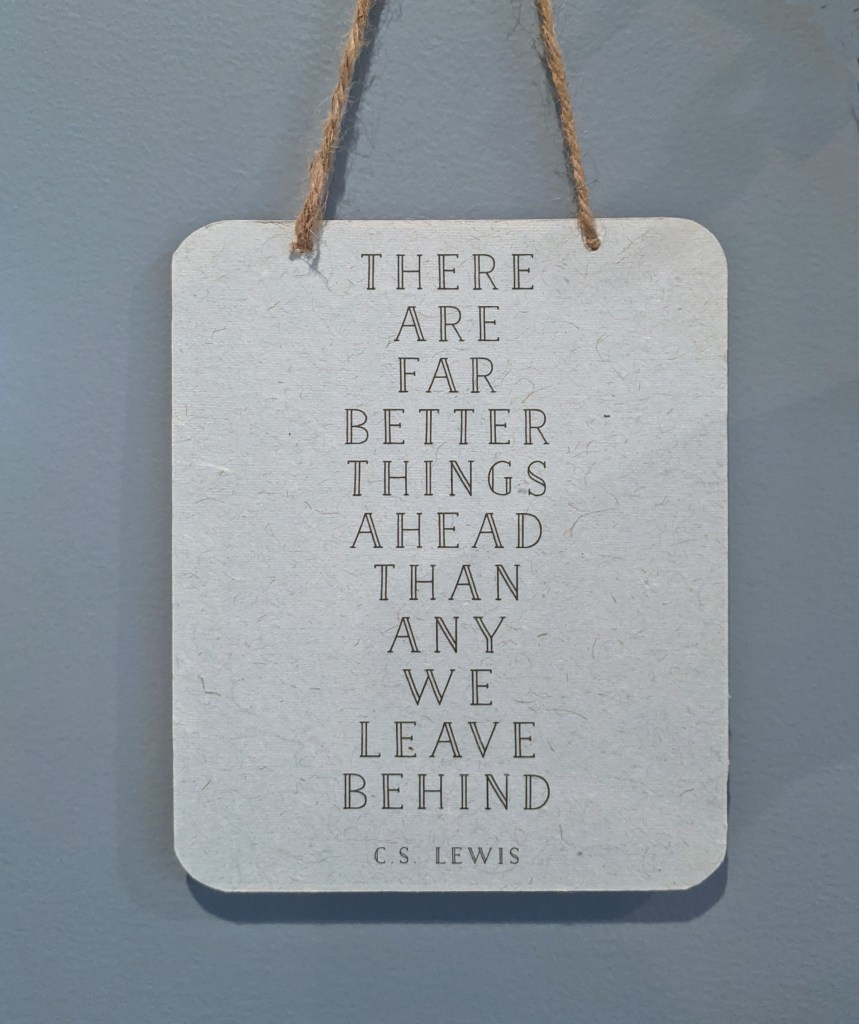
I’ll never be an SV, embracing change with gusto. My first reaction will always be to think of everything I’m giving up. The trick, I’ve learned, is in not letting those hold me back. A couple years ago, my best friend gave me a lovely plaque with a C.S. Lewis quote, and I’ve hung it beside my mirror, so each morning I can remind myself, “There are better things ahead than any we leave behind.”
Note to my white male readers: Today’s post may seem like it’s directed solely at employees of color and women, but white males, stick with me: I promise there’s stuff in here for you, too.
I’ve never been fortunate enough to be part of a strong affinity group (also known as an employee resource group, or ERG), and I envy those who are. These can be key to helping people who are not white men find like-minded colleagues and survive environments where they’re often the only non-white/non-male/non-straight/non-[fill in the blank]. If you’re like me and don’t work at a place that has robust ERGs, do what I’ve done and create your own. (More on this in a future post.)
But a few months ago, I was watching (of all things) a video from Marvel announcing their Phase 5 movie plans, and I realized something: Affinity groups are great, but if you want to get ahead in your career, it’s highly likely you need help from a white male.
I can’t find the Marvel video, which is driving me crazy, but it was about 20 minutes long and featured Kevin Feige and various Marvel VIPs touting the diversity of planned MCU projects: directors who are female and people of color, stories built around Asian, Muslim, female, LGBTQ and otherwise non-white-male leads. It was (pardon the pun) marvelous. It made me want to cheer.
But about halfway through the video, I realized that every single time they talked about the decision to hire a non-white male or feature a non-white-male-centered story, they said some version of this: “So then [white male executive/director/famous actor] said, ‘I think we should hire [female or POC or LGBTQ director or actor].”
In other words: White men were the gatekeepers in all of these scenarios.
Most of the directors and actors chosen for the new slate of diverse content are veterans who’ve demonstrated their talent and ability. But they needed a white male to open the door and invite them into the MCU.
And it’s not just Hollywood. When Joe Biden promised during his campaign to choose a team that “looks like America,” it boiled down to the same thing: A group of female, people of color or LGBTQ professionals who are incredibly accomplished and credentialed, who’ve put in the time and proven themselves … and still needed the blessing of a white male gatekeeper to ascend to this level (or in the case of the Cabinet, dozens of white male gatekeepers, since Cabinet secretaries need Senate approval).
Most of the directors and actors chosen for the new slate of diverse content are veterans who’ve demonstrated their talent and ability. But they needed a white male to open the door and invite them in.
Take Kamala Harris, for instance. If you look at her career path, it’s a series of opportunities given to her by men who recognized her talent and hard work and opened doors for her, up to and including Joe Biden asking her to serve as his running mate.
Janet Yellen is the same. She’s historically credentialed as the “first person to have headed the Treasury, the central bank and the White House Council of Economic Advisers,” the three most powerful economic positions in the nation. And she got each of those positions by being tapped by a man: Bill Clinton, Barack Obama and Joe Biden.
My point is not to take away from what any of these people have accomplished. As I’ve said, all of them are talented and noteworthy on their own. My point is that, despite their expertise, none of them would have achieved the level of success they now enjoy without an outstretched hand from a male (and 99% of the time, a white male).
All of this made me realize: Affinity groups can be super helpful. I truly believe that companies that are serious about diversity, equity and inclusion should have strong ones, and if you’re a minority of some kind (female, person of color, LGBTQ, etc.), you should seek out one or form your own informal one, as I’ve done. But you also need to be intentional about cultivating white males.
The key to success isn’t just having the right credentials or a willingness to work hard. It’s knowing the right people and getting them to sponsor you. And the right people are almost always white.
Even when minority students are fortunate enough to attend the elite colleges that feed most power structures, they often occupy a different universe than their white male counterparts. This fascinating report, for example, found a common experience of “neo-segregation” in higher ed, where “colleges eagerly recruit black and other minority students, but actively foster campus arrangements that encourage these students to form separate social groups on campus” such as “racially separate student orientations, racially-identified student centers, racially-identified student counseling, racially-identified academic programs, racially separate student activities, racially-specific political agendas, racially-exclusive graduation ceremonies, and racially-organized alumni groups.”
I get why colleges – and employers – do things like this, and why students and employees enthusiastically participate. It feels so so good to be with people who look like you, and think like you and just plain get you … to not be the only non-white or non-straight or non-cis person in the room. When my company does some well-intentioned but boneheaded thing around DEI, my first move is to text my friends of color who also work there to say, “Did you see …? Can you believe …?”
But here’s the thing: None of that has necessarily helped to advance my career. The key to success isn’t just having the right credentials or a willingness to work hard. It’s knowing the right people and getting them to sponsor you. And the right people are almost always white, and a lot of the time they’re male. Affinity groups are great and a boost to the soul … but if you want to advance your career, save plenty of time and energy for cultivating white men.
And to my white male readers, let me be clear: No one is blaming you for the systemic advantages you’re born with. Well, maybe a little, but most of us recognize that the good ones among you (like my wonderful husband and so many of my friends) wish the system weren’t built this way. If you made it all the way to the end and are reading this, I hope your reaction isn’t, “Wow, I have so much power!” but, “This is kind of messed up. How can I use my systemic power to try to change this?” That’s what the white men I admire, like my husband and friends, are doing, in big and small ways. If you’d like to join them, here are some great articles on how to be an ally:
I’m fortunate enough to live in an area with a terrific library system that does amazing free programs, including wine/cheese/chocolate tastings. Free night out with food and the chance to knock out an errand by returning library books? Yes, please!
I enlisted two friends, and we ended up at a table with a woman who immediately made clear she was there under duress.
“I didn’t even want to come,” she announced. “I nearly didn’t. But my husband said, ‘You’re always saying you want to meet more people.’”
Here’s the thing: If you’re nervous about meeting new people, you could not ask for better people to sit with than my friends and me. We take this kind of thing as a personal challenge.
“I’m so glad you decided to come, and that you sat with us!” friend RG said.
“Yeah, you hit the jackpot tonight,” friend JVM joked. “We love meeting new people.”
We made it a point to make lots of eye contact (super important to making people feel genuinely welcome). We talked only about general things, so she could join in. When it came time to get in the line, we said, “Oh, let’s go now – don’t you agree?” directly to her. Bottom line: We were trying HARD.
But apparently, not hard enough for her, because a few minutes later, we realized she had disappeared.
Me: “Uh, did that woman bail?”
JVM: “Yes, yes, she did. Wow.”
RG: “Oh honey. It’s good that you came … but you gotta open up, too.”
What is it about meeting new people, even people who are also new to a place and are being friendly and welcoming, that requires so much energy and courage? I think this is something that’s always been challenging, but now, with entertainment devices constantly on hand, it’s a skill (and I do think it’s a skill) that we rarely practice.
To initiate a conversation risks seeming annoying … or worse, weird. Everyone is focused; many are wearing ear buds.
Before smart phones, you’d end up talking to strangers out of sheer boredom – in line, on buses, while having a drink at a bar or waiting for the church service to start. You had dozens of chances each month to practice the art of small talk, of coming out of your shell enough to meet someone, maybe even make a connection. Even if you weren’t the type of person to initiate a conversation, enough other people did it that you were forced to engage.
But now, to initiate a conversation risks seeming annoying … or worse, weird. Everyone is focused; many are wearing ear buds. And fewer and fewer people are even out of their houses to begin with. Streaming movie services mean no more recommendations from strangers at the video store; food delivery means no more casual chats with the people sitting next to you. Membership in social groups, service organizations and churches is way down.
People, we are lonely. And it’s our own fault. We think it’s better to be alone, playing a game on our phones, than to talk to strangers. And that does sound better, right? I’m an extrovert who can talk to just about anyone about anything, and I never talk to strangers unless there’s a clear way to end the conversation after only a couple minutes, like in a fast-moving line.
Sign up to get an email whenever I post. If you sign up with your email address, I’ll send you my list of 26 items that comprise an Adult Male’s Appropriate Wardrobe for All Social and Professional Occasions.
But according to psychologists Nicholas Epley and Juliana Schroeder, that thinking is wrong. In the Journal of Experimental Psychology in 2014, they wrote about asking Chicago-area commuters on public transportation to predict which they’d enjoy more: solitude or conversation with a stranger. The commuters nearly all chose solitude, but when engaged by a stranger in conversation, they enjoyed it more than solitude.
So we’re isolating ourselves all under a mistaken belief that it’s better than talking to a stranger. This isolation is bad for our physical and mental health (and it can even impact our career opportunities and our worldview, as this New York Times article describes). Worst of all, it starts a negative cycle: The less time you spend going out and talking to strangers, the harder it seems, which means you do it less, which means you get less practice, which means it seems even harder, etc. And then you end up the person whose only friends are her kids, and they’re busy with their own lives.
That went to kind of a dark place, but you get my point.
So the moral of the story is: Make yourself go out, make yourself stay the entire time, resist the urge to use your phone as a crutch, and talk to other people. Go with a friend if it seems too overwhelming at first to do on your own, but then the two of you need to talk to people besides yourselves. Because as my friend RG said: You gotta come out, but you gotta open up, too.
I have an over-developed sense of appropriateness, especially as it relates to clothing. Two questions are always on my mind: What is the appropriate level of dressiness for the occasion, and what is the appropriate clothing for the weather/temperature/venue? After almost 20 years of marriage, my husband has learned to ask what I want him to wear before putting on clothes, because apparently changing once you have on an outfit is a hassle on par with, say, having to wrestle a 2-year-old into a full-length snowsuit and boots.
Me: “I know it’s hot, but men can’t wear sandals to dressy occasions.”
Husband heaves GIANT sigh, and my eyes roll out of my head onto the ground, because honestly, the list of advantages that women have over men when it comes to clothing is pretty flippin’ short.
I think this has its roots in my deep desire to belong, or at least to look like I belong. My nightmare isn’t showing up at school naked; it’s showing up at a company Christmas party in what I wore to work that day and realizing everyone else stopped at home on the way to change into nice dresses.
My nightmare isn’t showing up at school naked; it’s showing up at a company Christmas party in what I wore to work that day and realizing everyone else stopped at home on the way to change into nice dresses.
This also translates into judgmental tendencies toward both myself and others who are dressed wrong. (“Who cares that you think you wore the wrong outfit?” says husband to me often. “Just forget about it and enjoy yourself.” To which I reply: “Do you know me at ALL? The ability to let things go is not one of my spiritual gifts.”). In my defense, it’s not just me. This is also something I have in common with my closest friends. A common exchange:
BB: “She wore A COCKTAIL DRESS to their grandma’s funeral. Black. Low V neck. No hose. High heels with peep toes. On a blustery December day at a cemetery with super uneven ground. And she wore a short brown jacket that looks like what we would have worn to junior high.”
JVM: “Maybe it’s being a pastor’s kid, but I always have funeral attire. I even have some shoes that I keep just so I can stride confidently through the cemetery.”
Of course, wearing the right thing means owning the right things, because you can’t just dash home and change if you don’t have the item in your closet. So for this post, I decided to share some accumulated wisdom from my friends and me on what constitutes an Adult Woman’s Appropriate Wardrobe for All Social and Professional Occasions.
A quick aside: “Hey!” I imagine males protesting. “What about us?” This blog is intended for any and all genders, but this post is specifically for females because an Adult Male’s Appropriate Wardrobe for All Social and Professional Occasions is ridiculously simple (see earlier remark regarding the advantages men have over women).
Men need 26 items besides their everyday wardrobe. Want to know what I think those are? Sign up to get an email whenever I post, and I’ll send you my list of 26 items that comprise an Adult Male’s Appropriate Wardrobe for All Social and Professional Occasions.
Sign up to get an email whenever I post. If you sign up with your email address, I’ll send you my list of 26 items that comprise an Adult Male’s Appropriate Wardrobe for All Social and Professional Occasions.
So. Now that we’ve taken care of those identifying as males – ladies, here’s a list my friends and I curated of the building blocks of an Appropriate Wardrobe. Much of this is for women who work outside the home, but my SAH friends, there’s stuff here for you, too.
Note that I’m assuming here that you already have a solid everyday wardrobe for work or outings with friends. This is what you need besides that:
3 interview outfits. Unless you’re in finance or law, you can probably get by without a suit nowadays, but you should have 3 business-friendly dresses, or skirts with dressy tops. Think simple and sleek – nothing too wild, too patterned, too ruffly or girly, too over-the-top. You want them focused on you, not your outfit. If you want to wear wilder stuff, save it for after you get the job.
Why 3? Because when you nail the initial interview, you need something to wear to the second- and third-round meetings most companies do.
A funeral outfit. It happens … and more often than you think, sadly. The good news is, this can be the same as one of your interview outfits.
A formal dress in a timeless style. You may only need this once or twice in your life, but it’s almost impossible to find in a moment of need without paying crazy prices. Comb the sale racks at your leisure, find a classic black formal dress or the like, and stash it away. Bonus points if it’s stretchy enough to accommodate fluctuations in size. (Important point from friend BB: “I’d clarify that ‘formal dress’ means more cocktail and less prom.”)
2 dressy coats – one lightweight and one winter. You find the perfect dress, you shave your legs all the way to the top, you get a blow-out and a pedicure … and you’re going to wrap all that in the same puffer coat you wear to the grocery store? This is another instance where the sale rack – or even better, the thrift store – can be your friend. My winter dress coat is a black faux fur I found at Goodwill that makes me feel like a queen. My spring/fall one is a fun black/gray check I found at an end-of-season sale for 70% off.
Flat-soled dress shoes or wedge heels. Outdoor wedding, team event in the boss’ backyard, graveside funeral service. You don’t want to be teetering around, prying up your heels from the lawn with every step.
2-3 pairs of dressy shoes and sandals you can wear all day on a concrete floor. I’m the cheapest person ever when it comes to clothes – 98% of my wardrobe is from thrift stores and clearance racks. But the one thing I spend money on is shoes. At the big annual trade show my company participates in, I’m standing on concrete from 7:30 a.m.-8 p.m. I pack 3 pairs of cute-but-comfortable shoes (changing them each day gives your feet a break) and a footcare kit that includes Epsom salts, moleskin tape and Band-Aids. Favorite cute-but-comfortable shoe brands: Toms, Clarks, Born, Vionic, Ecco, Naot, Dansko, Fly London. These shoes will cost you $100-$300, and they are completely worth it.
A work-event friendly swimsuit and cover-up. It is a hard fact that you should be able to wear whatever you want, including a small bikini to the team gathering at your boss’ lakeside cottage, without people throwing shade. It’s also a hard fact that once you see your coworkers mostly nude, you can never unsee them (and vice versa). I own a one-piece and cute coverup, plus a pair of board shorts and water shoes in the event some boss takes it in their head that white-water rafting or some such activity would be good for team-building.
A decent robe. This was also courtesy of friend BB, who noted rightly, “You just never know who might see you. Like, you don’t want to be outside with the neighbors, watching the firetrucks attired in a torn sleepshirt.”
A decent umbrella. NOT a freebie.
A nice work tote. Most days I carry an IKEA backpack, but twice a year I have a board meeting at my college with a group of people who wear suits and diamond rings the size of my head. For those situations, I pull out my Stuart Weitzman heels and my fuchsia leather tote.
So 15 years ago, after being obese my entire life, I lost 55 pounds.
At first, I typed “after being fat” … but that wasn’t accurate. I wasn’t just fat; I was genuinely, medically obese for pretty much all of the first 29 years of my life. From pictures, it seems like I was just a bit chubby up until about age 4, but I clearly remember in kindergarten being the fat kid: having the P.E. teacher sending me exasperated looks when I couldn’t crab walk more than a few feet without collapse, falling to the back and getting a terrible stitch in my side on a class walk to the park, having my best friend yell at other kids who were making fun of me.
When our first grade class staged a circus, the teacher made me the elephant, and even now, nearly 40 years later, I remember the sick feeling of humiliation and thinking, “Why did you have to call even more attention to the fact that I’m fat?” Each year when we were weighed and measured at school (do they still do this?), the nurse would call out to her helper each kids’ stats, but for me, she would whisper it in my ear. It was kind, but not particularly helpful. I remember one kid plaguing me the entire bus ride home to tell him what I weighed.
I was never bullied – I grew up in a small town with the same 100 kids in my grade all 13 years, and we all knew so much about each other that there was a sort of assured mutual destruction in picking on any one person too much; plus, as one teacher said to my mom, “We never really have to worry about SB speaking her mind, do we?”
“Fat” was always, always a part of my identity, from my earliest memories.
But “fat” was always, always a part of my identity, from my earliest memories, made even more stark by the fact that everyone else in my entire family, including grandparents, aunts, uncles and cousins, was average to thin. My parents alternately made jokes about my weight and worried about it. My mom, who only knows how to cook the way Iowans ate when she was growing up (meat, starch and sugar), would have bars or cookies waiting for us when we got off the bus, but also one day surprised me with a “gift”: a rowing machine that I had little interest in but feigned enthusiasm over because I knew it was expensive and that it was her way of trying tactfully to help me.
I tried numerous times over the years to lose weight, but by my 20s, I had pretty much accepted my identity as a fat person and was reasonably OK with it. But for some reason, the prospect of turning 30 lit a fire under me like nothing else. I woke up one day at age 29 and thought, “I have been fat my entire life. I’m not going to spend the rest of my life being fat.” I joined Weight Watchers, and within 6 months, I had lost 55 pounds.
It was awesome. I got loads of affirmation and compliments. For the first time in my life, I could shop in the normal part of the store, not the plus sizes. I bought sexy underwear and bras. I wowed everyone at my 15-year high school reunion. (“Holy s—! SB looks AMAZING!” a former classmate gasped when I left for the bathroom.)
Sign up to get an email whenever I post. If you sign up with your email address, I’ll send you my list of 26 items that comprise an Adult Male’s Appropriate Wardrobe for All Social and Professional Occasions.
The problem is: I wanted to lose another 10. This wasn’t some arbitrary goal: That additional 10 pounds would finally, finally move me from the “overweight” BMI category to the “normal.” I had already left behind “obese,” but I wanted, for the first time in my entire life, to be “normal.”
But I couldn’t get there. I faithfully adhered to my 18 points a day. (It was a cruel joke of WW at the time that the more weight you lost, the fewer points you got.) I stopped using my weekly 35 bonus points. I bought an elliptical machine and used it 40 minutes a day, every day. I read every article I could find on how to get past a weight-loss plateau.
The scale would not budge. And I could not let it go.
“You look so great!” people would say.
“Thanks!” I’d reply. “But I want to lose another 10.” And they’d nod in understanding.
Fifteen years later, not only have I never lost that additional 10, I’ve gained back 15. I no longer fit into some of the clothes I bought in those first heady days. I feel like a cushiony chub next to the svelte women at work. I obsess over my back fat.
In short, I would give ANYTHING to be the weight I was back then. Remember: the weight I wasn’t OK with, that wasn’t enough?
I read an article a couple years ago about a woman who took her 93-year-old grandmother out to dinner for her birthday, and when she suggested ordering dessert, her grandma said, “Oh no, I’m on a diet.” And the woman thought: “What? When does it end?”
I wish I’d saved that article (I tried desperately to find it as I was writing this post, but I couldn’t), because it was an epiphany for me. Oh, I thought when I read it. OH.
The writer, who is in her 40s, said she looks back at pictures of herself in her 20s and, remembering how much she hated her body when she was that age, wishes she could go back and tell her 20-something self how good she has it. And then she realizes that when she’s in her 50s, 60s, 70s, she’ll likely look back at her current self and think, “Why didn’t you realize how good you have it?”
A few years ago I went snowshoeing for the first time. I was with friends, and we chose what we thought was a 2-hour trail but instead was a 6-hour trail. You know, one of those situations where, by the time you realize, it’s just as hard to go back as to go forward? Snowshoeing is surprisingly easy – it’s basically just walking – but after several hours, my right hip was hurting in a way that made me think that at age 80, I was going to be pointing back to this as the turning point for when my hip went bad. My friends were in similar shape – numb feet, aching joints. All of the horsing around we’d done in the first couple hours was long over; we were now on a grim mission.
Then my friend RB, who’d become our leader by dint of being the only one who’d ever snowshoed before and being one of the most sensible people I know, held up her hand for us to stop. “Friends,” she said, “Let’s pause for a moment and give thanks. We are so blessed to be here, in this moment, and to have bodies that can do this.”
Snowshoeing is just walking, but it burns a LOT of calories, y’all.
Wow. Have I ever been thankful for the body I have at this moment?
David Brooks said in “Bobos in Paradise” that the defining American characteristic is that we’re aspirational; no matter their age, gender, religion or country of origin, what makes someone American is that they believe better is possible. Other countries accept things as they are and as they’ve been for decades, even centuries. Americans: No way. Whatever the now is, it can be better. We can be richer, thinner, happier, smarter, busier. The grass is always greener.
New York Times writer Sarah Miller had an article I loved titled, “The Diet Industrial Complex Got Me, and It Will Never Let Me Go.” “My weight has probably occupied 50 percent of my thinking for my entire life,” she wrote. “Even if I don’t fat shame others, I cannot stop fat shaming myself, and yes, I know this means that I am sort of also fat shaming others by doing so, but, as you may have gathered, I can’t stop … It is too late for me, and it’s too late for pretty much everyone my age. We are so brainwashed.”
Have I ever been thankful for the body I have at this moment?
Miller’s right; it’s too late for me to ever be fully healthy in how I think of myself. But what I can do is follow the example of my friend R: Despite the hurt, despite the discomfort, to remember to stop and give thanks this moment for the body I have now and all it can do, so that 10, 20, 30 years from now, I can look back on that body and know that I had some appreciation for it and recognition that, relative to others now, and to my future self, it’s beautiful and healthy and enviable.
Today’s post comes courtesy of a question from a terrific college student I connected with recently, after speaking at a fabulous Florida Women in Business panel on diversity and inclusion: “What advice would you give to young people about internship or first job interviews, especially if they don’t have as much experience to speak on?”
This is the classic dilemma, right? It’s hard to get a job or internship without experience, but how are you supposed to get experience without a job or internship?
Work your network
The best advice for finding a job or internship, no matter how much experience you have, is to work your network and be willing to relocate, even just temporarily.
“But none of my friends have jobs either!” you say.
What about your parents? Your parents’ friends? Your friends’ parents? Your professors’ friends? Former classmates who already graduated? High school friends? High school teachers’ friends? You see where I’m going. Someone you know works at a place offering internships, or knows someone who does. Ask anyone and everyone for suggestions and referrals.
Someone you know works at a place offering an internship or job, or knows someone who does. Ask anyone and everyone for suggestions and referrals.
Think like a man
And don’t be afraid to apply for stretch positions. Here’s something I wish I’d known in my 20s: Job descriptions tend to be less an accurate description of what the job will actually be, and more a wishlist of what everyone with a say wishes the person would do. Sample comments: “Wouldn’t it be great if the person knew Photoshop?” “And had graphic design experience?” “And was a good writer?” “And could operate a forklift?” “And could build furniture from scratch?” They know they’re unlikely to get someone who can do all of these things, but they figure it’s worth a shot.
Sign up to get an email whenever I post. If you sign up with your email address, I’ll send you my list of 26 items that comprise an Adult Male’s Appropriate Wardrobe for All Social and Professional Occasions.
Numerous studies show that men will apply for positions where they don’t meet all the criteria, but women will only apply when they meet every single qualification. My advice is to think like a man and, if you meet at least 60% of the criteria, go ahead and apply. You have little to lose, and you may be pleasantly surprised.
Focus on fit
Here’s another thing I wish I’d known in my 20s: If you get an interview, that means they’ve already decided you meet their requirements on paper. Your goal during any interview is to demonstrate that you’d be a good employee and someone they want to work with. It’s also to make sure, on your part, that this position is a good fit for you.
This last part is tricky when you’re first starting out because you kind of need any experience you can get. At the same time, if you know that you consistently have trouble making it places on time, hiring on somewhere that’s a stickler for punctuality is setting yourself up for failure. So be realistic.
I had a recruiter contact me last week about a really great job opportunity that included crisis communications for a 3-state territory. So at any moment, I might get a call and need to drop everything and drive 3-5 hours to talk to the media. Fantasy SB found this idea exciting. Real SB recognized that a) this would be a huge challenge for my family, since my husband also works full-time; b) these calls would inevitably come during a blizzard, and if I hated the idea of driving the 15 minutes to my current job in bad weather, I would not be excited about driving multiple hours.
The power of preparing ahead
In terms of convincing them you’d be a good employee … the No. 1 thing I always tell people is to practice practice practice. Find interview guides online and make friends or family interview you. A lot of companies ask behavioral-based questions and are looking for answers that follow a SAR (situation, action, resolution) or STAR (situation, task, action, result) format:
Situation: An event, project or challenge
Task: Your responsibilities and assignments
Action: Steps or procedure taken
Result: Results of actions taken
Google “behavioral interview questions” (this site, for example, has some typical ones). Then draft answers and rehearse until you could say them in your sleep.
Google “behavioral interview questions.” Then draft answers and rehearse until you could say them in your sleep.
When asked about a time you worked with someone difficult or who didn’t listen to you, a good SAR answer would be, “[SITUATION] Last semester I had to do a group project with someone who just wasn’t as invested as I was. He didn’t show up to any of the meetings, he ignored my emails and texts. It was so frustrating because this was a big part of our grade. [ACTION] I even tried knocking on his door and talking to him in person. Finally, I reached out to the professor to ask if I could change partners. He said that wasn’t possible, so I ended up doing both his part and mine because I didn’t really see another option. [RESOLUTION] However, I was clear in my notes to the professor and in my presentation that this was a solo effort. I didn’t want to be vindictive or throw my supposed partner under the bus, but I also didn’t think it was appropriate for me to cover up his negligence. That seemed unethical, and it didn’t do justice to the extra work I had had to do.”
So this situation has a lot of landmines that I tried to adjust for. This is why writing out your responses and rehearsing them ahead of time is critical. You don’t want to sound like a whiner or victim, or like you’re trying to claim all the credit and want people to laud you for your amazingness. None of those are attractive qualities in an employee. You do want to sound like you’re a problem-solver, a team player, someone who takes the initiative and can succeed under duress, but also someone who values integrity and who can stand up for herself.
When rehearsing, you need a friend who will be honest with you and critical about body language, things you’re saying that may be coming off the wrong way, tone of voice, etc. You can also ask a friendly adult to interview you. I interviewed one girl for an internship who spoke so softly, I could barely hear her, and gave really short, unhelpful answers. I threw her every lifeline I could think of, and she still floundered.
Another guy I interviewed for an internship, when I asked him to name his proudest accomplishment, told me he had lost 100 lbs. And when I asked him to tell me about a challenge, he told me his brother had died. Both of those were – wow. I mean, congrats on the amazing weight loss, and I’m so sorry about your brother, but I wish you would have related both of those to how you would do working for me. Like, even if he had said, “A few years ago I lost 100 lbs. That taught me self-discipline and focus that I think has also been reflected in my work,” that would have been so much better.
Also, he was 20 minutes late for his interview without any excuse. Don’t do that. (See “Avoid unforced errors” below.)
And when it comes to your lack of experience: Use the interview questions you find online to help you prep responses that highlight any transferable skills you have from summer jobs, school, volunteering, etc. Group projects are not all that dissimilar to team projects at work, sadly. Don’t apologize for your lack of experience – you’re in your 20s; no one expects you to have 10 years of management experience. Just show you understand how to take what you’ve learned at college and your job folding T-shirts at the mall, and apply it to the workplace. For example, the college students who organized that Florida Women in Business panel did a better job creating and facilitating it than 90% of the ones I’ve attended at work. That’s an amazing accomplishment, even though it was a volunteer gig, not a paid job.
Avoid unforced errors
Finally, take note of some of the most common interviewee unforced errors, and avoid them:
Dress appropriately. It’s perfectly OK to ask the person setting up the interview for you what to wear. This makes you look mature and planful. I also like to dress a step above what’s normal for the company – e.g., if most people wear jeans and nice shirts, I’d wear to the interview a skirt or slacks.
Show up on time. If you’re late or have technical problems, own it, remain calm, apologize and carry on.
Don’t interrupt. This can be tough when you’re nervous and eager, especially if you’re on the phone and lack visual cues. If you do, quickly say, “I’m so sorry – please go on,” and then wait for either a clear question or a pause of at least one second.
Don’t ask questions you can easily look up online. Showing that you’ve done your research and understand what they do and what they’re looking for shows that you’re thorough and prepared.
Don’t trash previous employers. It’s tacky and unprofessional. If you’ve been let go from a previous job due to economic reasons, a simple, “Then the pandemic happened” will suffice. If you were let go for what you consider to be unfair reasons and you hate them with a holy hatred, practice a neutral story like, “It wasn’t a good fit” or “I’m looking for new opportunities” or “I’ve always been passionate about [whatever industry the job you’re applying for is in].”
Don’t swear. I was once interviewing a candidate I liked so much. She brought homemade cookies to the interview! She was warm and personable and seemed awesome. Then when I asked why she was looking to transition, she said, “My current boss is always up my ass.” Cue needle scratch.
Scrub your social media. This is one of the first things employers check when someone applies for a job. If there are pics of you doing keg stands or lighting up, remove or hide them immediately, and untag yourself from friends’ pics.
Stay off your phone. When you arrive at the interview site, put it in silent mode and put it away. If you need to get it out to take notes or look something up, give a quick explanation – “Sorry, what you said was so awesome, I just want to jot it in my Evernote before I forget” – and then put it away as soon as you’re done.
Don’t lie. It’s OK to stretch the truth a bit if you’re confident you can deliver – e.g., positioning yourself as a Photoshop expert when in reality you’ve only used it a few times, but you know you can watch some YouTube videos over the weekend and get up to speed quickly. What’s not OK: Pretending to have your master’s when you don’t even have your bachelor’s, or saying you have experience planning corporate events for hundreds when the only event you’ve planned is your own birthday party.
Be careful about salary and benefit questions. I am all about asking for fair compensation and negotiating. But during interviews, whenever possible, I try to let the interviewer be the one to bring up salary and benefits. Companies want to believe you’re excited to work for them because they’re amazing, not that you’re doing this for filthy lucre, and if you bring up money, especially early on, you can seem transactional and mercenary.
There are ways to get a sense for this without asking outright, and you should practice these. For example, “What do you like about working here?” “What’s kept you here for X number of years?” “How long is the average tenure?” [High turnover is a red flag. At my first job, turnover was so bad, the handbook had a policy stating that only people who’d been there at least a year would get a going-away card. I lasted 15 months, and on my last day, my boss said loudly to someone on the phone, “Yes, we’ve been expecting her to leave for awhile now.”]
Often in the prescreening call, the recruiter will ask you about salary expectations. My first go-to is to punt and say, “A lot depends on the total package – benefits, vacation time, retirement contributions, bonuses, etc.” This is all true – my friend JVM worked at a place that didn’t pay super well but put 15% into retirement funds and gave 4 weeks of vacation.
If they still press for an exact number, give a range – e.g., “I’m hoping for $45,000-$55,000, but as I said, it all depends on the total package.”
You can also try a great tip from my friend JW, who suggested saying, “My goal is to be in the 75th percentile of the range.”
Do you still have questions? Any seasoned interviewers out there who have anything to add?
Has your life started yet? And if so, when do you think of it as having started? And if not, what are you waiting for?
What do I mean by “started?” Well … I don’t really know, exactly, but it’s that indefinable sense that you’re no longer waiting for some sort of official blessing to start living your life. You’re no longer thinking, “I’ll do that as soon as ….” I’ll get my own place, maybe even buy a house and non-IKEA couch, I’ll make a will, I’ll figure out some sort of financial plan besides the savings account at my bank.
Oh, you say. You mean, when did I become an adult? Well, yeah, kind of … but I know a lot of people who are very capable adults – working high-powered jobs, doing their own taxes, cooking and grocery shopping – but they’re still waiting for … something.
For most people, both men and women, I think, marriage has often been the moment when they think of their lives as starting. Now it’s official! I’ll buy a house, I’ll register for nice dishes, I’ll buy a fancy couch, I’ll make a will, I’ll hire a financial advisor. Because that’s what married people do. Becoming a parent is typically the other trigger – the momentum of that, the way parenting hurtles you forward through life whether you’re ready or not, doesn’t leave a lot of time for waiting around.
I know a lot of people who are very capable adults – working high-powered jobs, doing their own taxes, cooking and grocery shopping – but they’re still waiting for … something.
This was all well and good 50 years ago, when the average woman in the United States was married at 20 and the average male at age 23. But now the average marriage age for both genders is closing in on 30, which is kind of a long time to wait to start your life. The age at which people become parents is also trending upward. And more Americans than ever are staying single: In 2017, 45.2% of American adults over the age of 18 were unmarried, compared to only 28% in 1960.
I know a ton of single, childless people in their 30s and 40s. Some of them are still waiting. Maybe they’ve bought a house, but they haven’t really decorated it. (These tend to be guys; they’re waiting for a spouse.) Or they have nice dishes, but not the ones they really want; they’re waiting to register for those.
But others have found there’s another way to know if their life has started: They’ve decided to start it.
Sign up to get an email whenever I post. If you sign up with your email address, I’ll send you my list of 26 items that comprise an Adult Male’s Appropriate Wardrobe for All Social and Professional Occasions.
My best friend, J, is a gorgeous woman in her 40s who’s single and childless. She was in a long-term relationship in her 20s that everyone, including her, thought was leading to marriage, but for a variety of reasons, she found herself single at 30.
Around that time, she decided she was done waiting. She bought the dishes she’d always wanted. She started going on big vacations, with friends but also by herself. She bought new furniture. She amped up her retirement contributions. She hired an attorney to make a will. (In case you’re wondering why I keep bringing that up: If you have any assets at all, even just a 401(k) plan through your employer, it’s the kindest thing you can do for your nearest relatives. It costs just a little but saves so much hassle.)
She’s not alone. In 2019, single women made up 20% of home buyers, and that number is continuing to grow. And they’re not only buying homes; they’re doing major renovations, intended to please themselves and only themselves.
Most importantly, they’re no longer waiting to be happy. Writer Shani Silver said in a 2019 article, “I mentally saved so many things ‘until I get married,’ because they were things I thought I should share with someone else … I don’t think I should wait for things that will bring me joy, just because someday I’ll get married, someone might buy me things off my wedding registry, and then I’d have two. I think my present-day happiness matters more than a list of future items to return to Bloomingdale’s. I also had to come around to the idea that my solo apartment isn’t temporary housing. It isn’t where I’ll live ‘until I meet someone,’ it’s just where I live. And I want to make it a place I’m proud of. I can save up for a nice couch, and not worry that it’s too feminine for a man I might move in with someday. I want to look around and love where I am.
“I think there was a fear that if I treated single life as permanent, it would be a self-fulfilling admission. It’s perfectly fine to live a single life fully, with permanence, positivity, and really nice pots. It doesn’t mean I’m admitting to myself that I’m never going to meet someone, instead it means I’m going to enjoy the days before I meet someone just as much as the days after.”
Exactly. So follow the example of all these people, and buy the nice dishes, the ones you’d register for if you were getting married. Or if dishes aren’t your thing, buy whatever is the equivalent for you. Make your home a place you’re happy to live now. Find a financial advisor. Start planning your dream vacation. Don’t wait for someday; start your life now.
I like to get right to the point, and I know you’re probably reading this on your phone and scrolling is a giant pain, so let’s just cut to the chase: Drinking at a work lunch is a landmine, and it’s usually best to steer clear.
I’m guessing reactions to this statement will fall into two distinct camps:
Duh. Obviously. People have to be told this?
What? Nuh-uh. I go to lunch with my boss/colleague/client all the time, and he/she is super cool and never blinks when I order a drink.
I chose this topic for my first blog post because one of the last pre-pandemic events I hosted was a workshop for a couple dozen people who were mostly in their 20s. Lunch was at a Mexican restaurant a few blocks away, and my co-host and I sent the group ahead while we waited for a few stragglers. By the time we got to the restaurant, everyone was seated and digging into chips and salsa … and some were also enjoying large margaritas.
So to recap: These people had a) ordered drinks; b) at a work lunch; c) where they were guests; d) without waiting to see if their hosts suggested doing so, or ordered one themselves; and e) these drinks were large cocktails.
Let’s unpack each of these points one by one.
First, alcohol is always subject to scrutiny, especially at a seated meal. This is true at work and personal events. It’s like ordering food as a woman – fairly or not, people immediately draw all kinds of conclusions based on what you order.
Drinking at a work lunch is not that common, whatever your experience has been thus far. This isn’t “Mad Men;” if you order a drink at lunch, especially if you do so right away, without anyone urging you to do so, reactions are likely to range from a raised eyebrow to thinking you’re a lush with a problem. Also, keep in mind that work lunches tend to be short and/or involve people driving afterward. Tossing one back and then getting in a car is never a great idea.
Being someone’s guest means following their lead. This is true whether you’re at their home or a restaurant. You don’t walk into a host’s house and immediately start opening cupboard doors to look for a plate or glass. Similarly, when you’re someone’s guest at a restaurant, you let them set the tone. Here’s a sample of how this can work:
Server: “What would you like to drink?”
Host, to you: “Go ahead – what would you like?”
You: “Why don’t you go ahead? I’m still thinking.”
OR
You: “I’ll start with water. I may get something later, once I decide what I’m ordering.”
Remember, nothing bad ever happened to someone who stuck with water. And if your host orders a drink and encourages you to do so, you can always change your mind and order a professional drink.
Sign up to get an email whenever I post. If you sign up with your email address, I’ll send you my list of 26 items that comprise an Adult Male’s Appropriate Wardrobe for All Social and Professional Occasions.
What’s a “professional drink?” It’s a drink that’s low-key and unfussy, something you can sip with dignity. Some good rules of thumb:
Order something less expensive than what your host ordered.
When in doubt, err on the side of a simple glass of wine or a beer.
Avoid anything that draws attention to itself – e.g., over-the-top garnishes, giant size, colors not found in nature, sexual names, anything popular on spring break or cruise ships, super boozy drinks like Long Island iced teas. (Also, LIITs make you look trashy. I’m sorry, but it’s true – Google it.)
This drink has dignity. It says, “I’m a professional adult.”
My 9-year-old daughter begged me to order this drink because she saw someone else with it and thought it looked fancy. Let that be a lesson to you.
Professional drinks: beer, wine, anything in a lowball or old-fashioned glass such as a gin + tonic
Unprofessional drinks: bloody Marys with strips of bacon and giant celery stalks sticking out of them, fishbowl margaritas, shots, Long Island iced teas (I know I said this already, but it bears repeating) … or, at the opposite end of the spectrum, anything super complicated or pretentious (“Tell me about your smoked salts.” “What brand of bitters do you use?”)
And never, no matter what, order a second drink at lunch.
“But SB!” you protest. “My boss always orders a drink at lunch!”
Here’s a good time to remember a hard truth: You and your boss are not the same. By definition, she is in charge, and she gets to do whatever she wants, at least when she’s not with her boss. You, meanwhile, are the minion, and you must act as such. That means filtering what you say and how you act to give the best impression of professionalism at all times. Which is hard to do when drinking a giant margarita.
(Incidentally, the same is true when it comes to being on time for things. Your boss gets to keep you waiting. You do not get to keep him or her waiting.)
Returning to the lunch and the guests who had ordered margaritas without waiting for us: My first impulse was to say a stern, “Uh, this isn’t that kind of lunch.” My co-host, on the other hand, a woman older and wiser than I, simply smiled and said graciously, “How nice that you made yourselves comfortable while you were waiting. Would anyone else like a drink?” Which immediately eased the tension in the room among those who recognized the etiquette violation.
This was a good lesson for me: They may not have been good guests, but we were still good hosts, and a good host doesn’t shame her guests; instead, she makes everyone comfortable and smooths over potentially awkward situations. Even mentors need a mentor.
One of my favorite former bosses was responsible each year for organizing the Martin Luther King Jr. Day breakfast that our company hosts for hundreds of community members. A few years ago, she told me she woke up around 2 a.m. the night before and thought she’d forgotten to order the food.
I gasped. “What did you do?”
Deb: “You know, if this had happened when I was in my 20s, I’d have cried. In my 30s, I’d have been pissed off, looking for someone to blame. In my 40s, I’d have tried to make food for everyone. In my 50s, I’d have tried to order food. In my 60s? I went, ‘Oh well, I guess they won’t have breakfast,’ and I went back to sleep.”
I was dumbfounded. “So you did … nothing?”
Deb shrugged. “Here’s the thing you realize in your 60s, and especially after two bouts of breast cancer: It’s not that big a deal. This isn’t the end of the world. In fact, it’s not even close. Also, it turned out, I had ordered the food. So it was all good.
“I wish I could go back to my 20-year-old self and tell her just to calm down,” she added. “But the thing is: You have to go through each of the stages to get to this point. You can’t rush them.”
Did I forget to order food for the hundreds of community members we’re expecting? Oh well, guess they’ll have to settle for coffee.
She’s right on so many counts. I’m in my 40s, and there’s so much I’d love to go back and tell my 20-something self, most of all to calm down and that it’s not the end of the world. Also to treasure how much energy and free time I had back then. And to love my body and be grateful for its robust good health. And that just because someone is mad at you doesn’t mean you’re wrong. And so much more.
Even though Deb is right – you can’t just jump from the freak-outs of your 20s to the calm acceptance of your 60s – I hope there are other 20-somethings who might like to hear what I wish I could tell my former self. This is meant especially for those of you who, like me, are on a different path than their parents and don’t have a lot of people to guide them. My mom was a homemaker, and my dad was a truck driver and farmer. They were (are) loving and supportive, but they didn’t have tips about office politics or sexual harassment.
They also are white, whereas I’m Korean. I was adopted at 6 months and raised in rural Iowa where my sister and I were literally the only Asians and one of two families of color in the entire county. I grew up identifying as white, yet I realized as soon as I left the cocoon of my hometown that no matter how much I talked like them, ate like them, dressed like them and lived like them, white people would always see me as other. As much as my parents love me, they can never fully understand the feeling of betweenness that comes from not being white, but not being Asian either. (I call myself Fake Asian because I don’t speak Korean, have never visited there and know almost nothing about the culture, yet I look like the real thing and am treated as such.)
So if you’re in your 20s and need guidance, this blog is for you. I’m also fortunate enough to have a lot of really smart friends, and I’m already asking them to share their accumulated wisdom as well. If there are specific questions you’d like answered, post them in the comments. I’m here for you.
Sign up to get an email whenever I post. If you sign up with your email address, I’ll send you my list of 26 items that comprise an Adult Male’s Appropriate Wardrobe for All Social and Professional Occasions.













 Things I Wish I'd Known in My 20s